Showing posts with label China. Show all posts

Sunday, November 20, 2011

A Great Wall

Peter Wang, 1986 (8.7*)
The first American movie filmed in mainland China is a comedy of culture clashes. A Chinese-American computer worker in California , director Peter Wang, quits his job in a dispute, then takes his family to visit distant relatives in Beijing, China.

Of course, the Americans are now thoroughly westernized Chinese-Americans, so the family they visit in China is pretty much Old World by comparison. The bewilderment and confusion of host and guest alike stem from the language barrier for one, and again when confronted by peculiar foreign customs.

The best laughs come from the point of view of the People's republic, such as students reciting Lincoln's Gettysburg Address in unique English, or an elderly man coping with an electric blanket presented as a gift (and of course with a different current requirement), people debating fallacies about Americans as if factual, just like U.S. disinformation about other nations. This is all good-natured fun, with something to learn on both sides, and the benefit of it all going to the audience.

It’s a crime that less than 1000 people have rated this film at IMDB, it’s an excellent comedy, an excellent American film, and an excellent foreign language film, all three together in one.

Read more...

Saturday, June 4, 2011

Millennium Mambo

Hsiao-hsien Hou, Taiwan, 2001 (7.7*)
If you're a fan of the films of Hou or Hong Kong filmmaker Wong Kar-Wai, (best of which are Chungking Express and In the Mood for Love) or like me, you just like watching Taiwanese beauty Shu Qi (Hsu Chi, photo below) just walk around, you'll enjoy this film of Hou's.

Hou gives us a snapshot of the life of aimless Vicky, who does little more than hang around night clubs. She reflects back in the beginning of this on her relationship ten years earlier with Hau-Hau, a jealous house rock dj, who generally mistreats or ignores her and wants her to account for her time away from him or phone calls to others. Whenever they break up, he starts following her around again. We also see Vicky later in Japan, with a different man.

This is a not like a typical western film romance: boy meets girl, they have a relationship, then they (a) get married, or (b) part ways, end of film.. This is a segment of Vicky's life that covers roughly a decade, and we see scenes from each portion to give us a picture of her overall lifestyle. Much of the film is linked or propelled by electronic trance music, and it all fits together to create a very modern style, to me, reminiscent of Wong Kar-Wai.

Director Hou said in an interview that he wanted to show Taiwan night life and incorporate the trance music of Lim Giong (who co-wrote the music), so he used all Taiwanese actors. On the dvd, I like the longer, deleted "In Japan" segment that gives Shu some leeway as an actress to show more emotion than in the rest of the film, where she seems mostly just angered by life circumstances. She is certainly worth watching, as are all the films of Hou. He's definitely an artist, usually bringing visual poetry to the simplest of stories.

Winner of 6 awards, including a technical prize at Cannes

Read more...

Flowers of Shanghai

Hsiao-hsien Hou, Taiwan, 1998 (7.8*)
Without a lot of action, Hou paints a picture of life in upper-class brothels in Shanghai in the 1880's. The courtesans were known as "flower girls", hence the title. They were often bought as little girls, and kept in the house as servants until of age to go into the trade. Many never rose above servitude to become successful courtesans. In this tale, we see all types, but the stories center on several courtesans in their prime, and reveal to us all their gossip, conniving, and scheming.

Meanwhile, the clientele basically does little more than play drinking games and remain noncommital regarding taking better care of their mistresses. Many characters pass through the houses, yet Hou focuses on just key moments and conversations. Tony Leung is the best known of these actors.

The movie never leaves the internal rooms of the flower houses, and you feel a sense of the social circumstances that ensnares all the characters, whether they're patrons or the purchased. The cinematography is beautiful, as are the women, shot in the low-lighting of the interiorr spaces, very reminiscent of that in Kubrick's Barry Lyndon, shot in candlelight, with the same color palette as Wong Kar-Wai's In the Mood for Love.

Probably not the most involving of Hou's films, but one worth seeing nonetheless. It is ranked #898 on our compendium of all film polls

Read more...

Thursday, May 19, 2011

Raise the Red Lantern

Zhang Yimou, China, 1991 (8.7*)
In 20's China, nineteen-yr old Songlian, wonderfully played by Gong Li, China's best actress, is forced to marry a wealthy merchant after her father's death. The fifty-yr old 'Master', Jingwu Ma, already has three wives in a strictly ritualistic and traditional household. Each wife has her own home within the family compound, with the wives grouped together.

Each night he decides which wife to spend the night with, and the servants place a red lantern in front of that door. With favoritism from the master, wives gain more status within their own group, and of course any new wife is looked upon with suspicion and immediately jealousy. First Wife (Shuyuan Jin) tries to maintain her own superiority among the women; at least for seniority, her position can never be usurped. However, with each new wife, she risks losing more of the Master's favor, his time, and at the same time faces possible unions among her spousal rivals.

This is an interesting look at a culture not found in the west. As such, it was the first of Zhang Yimou's films to find large interest on our side of the planet. Add to that gorgeous cinematography, and the interest of women being considered little more than property in a patriarchal society, where their paths are chosen for them, and their lives are held under rigid and strict traditions, and you have a film that spoke of universal concerns and values.


Lantern won 15 awards, including 10 for best foreign film, a couple more went to the beautiful cinematography of Fei Zhao

For more of Zhang Yimou, see these reviews:
Hero (2002) China [my favorite]
House of Flying Daggers (2004) China
The Road Home (1999) China
To Live (1994) China [2nd favorite]
Not One Less (1999) China

Read more...

Wednesday, May 18, 2011

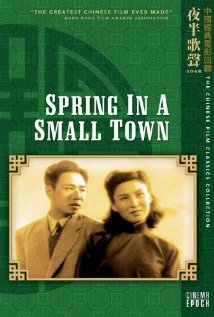
Spring in a Small Town

Mu Fei, China, 1948, bw (8.2*)
Spring is a gentle story of another era in Chinese films, one just after the war, in a world where this war reach out and touched even the lives of simple country people like the central character, Yuwen, movingly portrayed by Wei Wei, who is isolated in a small town, and in an arranged marriage with an ill husband, Liyan (Wu Shi).

The story revolves around memories: of love, and a period of promise, now being stirred to life again by the sudden visit of the husband's long estranged friend Zhang (Wei Li), who is now a city doctor, also a former beau of Yuwen. Zhang brings life back to the stagnant estate of Liyan, and renewed love and passion to Yuwen.

Complicating the story are the doctor's scruples and detachment, her husband's illness and depression, and his young sister's (Chaoming Cui) budding relationship with Zhang. Something subtle is happening and it's nothing as superficial as a straightforward romantic affair for anyone at the estate.

Spring is one of the most beautiful of all Chinese films because the beauty and love are just hints than actual expressions, as we'd find in films today. The world has been forever changed by war, and is coming out of it's winter, into a natural rebith of its own, mirrored by the natural spring all around. Liyan's younger sister provides the human metaphor for this natural springtime, one of renewal, spontaniety, and a natural reception to life and growth.

Read more...

Tuesday, May 17, 2011

King of Masks

Bian Lian, 1997, China-Hong Kong (8.4*)
In this true story, Xu Zhu plays an aging master of the ancient art of change, Sichuan Change Art, named Wang Bianlian who is known on the streets as King of Masks. He prefers to perform on the streets rather than seek more lucrative work in theaters or shows, as he seems to be inspired by the children in the crowds.http://www.imdb.com/title/tt0115669/awards

His wife has long gone, his only child is dead, so Wang has no male descendent to teach his rare art; masters require students trained to keep their craft alive. One night he chances to purchase an orphan boy, and the story of their friendship begins.

For those that want a change of pace from Chinese films which have martial arts, huge casts, and epic feel, this simple, unpretentious story is one of a rare handful. This is a beautifully made and touching story. Winner of 19 awards

Read more...

Monday, October 18, 2010

Zhou Yu's Train

Zhou Sun, 2004, China (8.1*)
This multi-layered romance will confuse some western audiences, boring many, and stimulate thinking and discussion about film style in others. A lot of what viewers will get from this will be based on what they take into it as experienced filmgoers.

On the surface, this is a simple romance about a porcelain painter, wonderfully played by Gong Li, one of the greatest Chinese actresses, who takes a long train journey twice a week to visit her lover, a poet (Tony Leung Ka Fai) who wins her heart with his tenderness and simple romantic poems to her he publishes in the local newspaper. She wants him to publish them in a book, feeling that he deserves a wide audience. She is also hounded on the trips by a brash but realistic vet, Honglei Sun, who begs her to quit traveling to a man not interested in commitment and stay closer to home, like with him. So she is pulled in two directions, one from the heart, one more from the body.

What makes this story more complex is that Gong Li plays a more modern woman with short hair, who also takes the train, and who is told this story from a third-person point of view, so we begin to wonder if this actually happened or is a fabrication of the poet as an author of a romance, perhaps based on the inspiration for his poems.

If you want a linear and clear story moving from A to C to get to conclusion D, this will frustrate you. If you enjoy Chinese films that are more about feelings, visual poetry, and life constantly in motion and change, then you will likely be haunted by this film for days to follow. I could make a case for either argument. Fans of the visual non-linear films of Wong Kar-Wai should enjoy this one from director Zhou Sun. Think French New Wave, a la modern China, with the rolling landscape and train also being major characters, as life is as much about the journey as the destination.

Note: Gong Li is so amazing that, as some said, I could watch her read the phone book. Her best film is Zhang Yimou's To Live (1994), winner of the Palm D'or at Cannes.

Read more...

Thursday, April 15, 2010

Red Cliff

International Version

aka Chi Bi
John Woo, 2008, 5 hrs, China (7.7*)

This is a giant-scaled and expensive war epic about a Han Dynasty war in 208 A.D. involving three Chinese empires. The Hans of the north invade a southern empire to quell smaller warlords, two of which form an alliance, but they are still overwhelmed in numbers by 800,000 to just 50,000. The invading king is really after the wife of the southern leader, a beauty he saw just once, but he also has a painting of her for inspiration. Lin Chi-Ling is appropriately breath-taking in this role, with a delicate flower-like beauty; she's a moving work of art herself and worthy of causing wars.

Lacking strength, the southern alliance, led by warrior Tony Leung and strategist Takeshi Kaneshiro decides to use a plan to force a decisive naval and land battle at a fortress on the Yellow River called Red Cliff, with the emphasis on attacking the invading fleet. Most of the film is a buildup to this battle, showing preparations in great detail. The special effects of the warfare are terrific, as this was one of the most expensive Chinese films ever made at 80 million, which means it looks like a 500 m film from the west. However, there is not much story here, at least nothing compelling, so this will please fans of war films due to the massive technical achievement but will not be that engrossing to more general fans.

There are two versions of this massive war epic from famed Hong Kong action director John Woo; make sure you see the complete five-hour film on 2 discs called the "international version", not the shortened "theatrical release".

Read more...

Wednesday, April 14, 2010

The Promise

aka Mo Gik; Wu Ji
Chen Kaige, 2005, China (8.0*)


Though not Kaige's best epic adventure romance, certainly one worth seeing. This fairy tale of a princess begins with a little girl stealing a bun for her dead mother and having a goddess descend to make a deal with her which will make her "a woman men will fight wars over." We then see her adult life filled with romantic intrigues and a love triangle based on mistaken identity, as she is courted by two kings and a slave.

This is full of magical images, similar to Ang Lee's Crouching Tiger, Hidden Dragon (2000), yet somehow lacks the powerful artistry of that film; the story is just not as original or poetic. However, the epic look and feel are here, as well as romance, martial arts, fantasy settings, and ancient warfare, all done with terrific CGI effects, which makes this another Chinese epic war romance a "must see" for fans of this genre. They can usually make films like this for $5-10 million, so luckily fans get several per year of this caliber, while in the west it's more like one per decade at a cost above 100 million.

Chen Kaige excels at epic films, such as Farewell My Concubine (1993) and The Emperor and the Assassin (1998), yet his best, most rewarding film for me is the small, intimate father-son story Together (2002).

Read more...

Friday, March 26, 2010

Together

aka He Ni Zai Yi Qi
Chen Kaige, 2002, China (9.5*)
Perhaps the greatest father-son story yet captured on film. Chen Kaige abandons his customary huge-scale epic costume drama to make a small intimate film about the intensely personal affection of a father and son. A poor worker from a small Chinese city (touchingly played by Peigi Liu) has a talented musician son who wins all the local violin competitions. He decides to take his son to Beijing to find a world-class music professor for his son at his own expense in order to elevate him to the level of professional international musicians.

This is a very engrossing and touching film with just five characters: the son, his father, two different music teachers, and a pretty young woman who befriends the teenage boy, in effect becoming a surrogate mother, and pays him to play privately for her. For me, this is Kaige's most successful story, and also his most innovative direction, which seems to have a very European cinematic style. A must for fans of classical music, especially violin music. Director Chen himself plays the more noted professor.

Note: Kaige is best known for large-scale costume epics such as Farewell, My Concubine and The Emperor and the Assassin

Read more...

Farewell, My Concubine

aka Ba Wang Bie Ji
Chen Kaige, 1993, China (8.2*)
A lengthy Chinese epic of three hours that covers 50 years in the lives of two Chinese opera singing stage brothers, and their romantic entanglement with the same woman. This ambitious epic weaves these stories around the history of China and its tumultuous changes over the entire 20th century. Perhaps a bit slow overall, this is nevertheless a huge scale accomplishment with a traditional epic look that is well worth seeing, featuring some classic scenes of war with thousands of extras.

Another epic of Kaige's worth seeing is The Emperor and the Assassin (1998), which won a technical jury prize at Cannes for production design. A royal courtroom where visitors approach the king by nearly walking on water is unlike anything else in cinema.

Read more...

Saturday, February 27, 2010

Devils on the Doorstep

aka Guizi Lai Le
Jen Wiang, 2000, China, bw (9.6*)
Absolutely terrific anti-war satire from China, is one of that country's best films ever, a grand jury prize finalist at Cannes. Wiang proves himself the consummate artist, writing the screenplay, then directing himself as the lead actor, putting himself on a level with Clint Eastwood and Woody Allen.

The story is simple on the surface: in a Chinese coastal village occupied by Japanese naval reserves during WW2, a peasant farmer whose prime concern is making love to his dead brothers' widow, receives a knock in the night (while fulfilling his goal) and is given two Japanese prisoners: a Japanese infantry soldier and his Chinese translator, by a resistance fighter, who instructs him to take care of them until New Year's, and to interrogate them, or he will kill all the villagers. When he doesn't return by that day, the villagers are faced with confusion and a major decision - what follows is a satire of war and moral dilemna, with much humor until the films concluding scenes. Watch for a hilarious scene where the translator has taught the p.o.w. how to curse the ancestors of his guards, as "the Chinese hate insults of their ancestors".

Wiang wisely shot this, beautifully, in black and white, recalling Kurosawa's masterpiece, Seven Samurai. Ironically, this film was banned in China, some say because the Japanese aren't shown as brutal enough, others because Wiang entered the film at Cannes without the government's consent. Whatever the reason, the entire world deserves to see this war mastepiece - there's no other film quite like it from inside or outside of China. Certainly one of that country's best films; only master director Zhang Yimou (Hero, To Live, The Road Home) has equalled this artistry.

Read more...

Thursday, January 28, 2010

The Kite Runner

Marc Forster, China-US, 2007 (8.4*)Khaled Housseini's award-winning novel is brought to life in a near-epic film by Swiss director Marc Forster (Finding Neverland, Monster's Ball), who seems to have a delicate touch in bringing out the humanity in the stories that he films. The story begins with the childhood friendship of two Afghani boys in the peace before the Soviet invasion of their country, which turns many into refugees. The most exhilirating and joyful scenes in the film are of kite flying in Kabul (filmed in western China), which usually involves trying to attack other kites and cut their strings.

The central part of the story involves a dramatic turn of events that changes the boys' lives forever, while the latter part shows the new lives of Afghani immigrants in the U.S., forced to flee to avoid Soviet reprisals against anti-Communists during the occupation of Afghanistan. The acting is superb, even the amateur child actors (one was a Broadcast Film Critics award-winner), and especially Khalid Abdalla, who was a terrorist in United 93. However, like most films of novels, it seems a bit of a synopsis of a longer novel. This is a tough story to bear, showing guilt, shame, violence, fear, hope and redemption - but one that should definitely be experienced by those of us in the west who have never had to endure an invasion of our homeland. Golden Globe and BAFTA nominee for best foreign film - why no Oscar® nomination, which it deserved? (the music was nominated)

Be sure to see Forster's Finding Neverland, which is Kate Winslet's favorite film of hers (and perhaps Johnny Depp's best performance), and also Jack Gold's Goodnight, Mister Tom (1998), which features John Thaw (of Inspector Morse fame) in his finest dramatic performance as an embittered widower in the British countryside forced to take in a London child evacuee during the WW2 bombings of England, one of the highest rated films at Netflix among viewers.

Read more...

Thursday, April 9, 2009

House of Flying Daggers

Zhang Yimou, 2004, China (8.1*)
Following his tremendous success with Hero, top-grossing film in Chinese history, Zhang Yimou continued with martial arts adventures with this story of a group of women who oppose the Tang Dynasty's male leaders continually involving the kingdom in wars. Believing if they overthrow the men and allow the women to take over, they can stop the wars and bring peace to the kingdom.

Ziyi Zhang (Crouching Tiger, The Road Home) is a member of the subversive revolutionary group known as House of Flying Daggers for their penchant of committing assassinations with daggers, made so that they can be thrown in curves, like a boomerang - so hiding behind a tree is useless. This is more exciting filmmaking from Yimou, who seems to have hit his stride in this genre: the historical, costume, epic action adventure, and the more intrigue the better. Along with Zhang, this stars Takeshi Kaneshiro and Andy Lau. Time Magazine and others called this the "best picture of the year".

Read more...

Tuesday, April 7, 2009

Fallen Angels

Wong Kar-Wai, 1995, China/Hong Kong (9.0*)
I recently re-watched this Wong Kar-Wai film because it had been remastered for dvd, and I couldn't remember it from over a decade earlier. I was surprised and riveted by the stunning visuals. Kar-Wai is a visual master, and this is one of the most visual of his films. This is the 'sequel' to his excellent Chungking Express, the two films being intended to be one long film by Kar-Wai but due to length he put them out as two separate films. Taken together, the films are either a trilogy or tetralogy, it's kind of hard to tell, but suffice to say that they are films of more than one story. These films were the inspiration for Quentin Tarantino's Pulp Fiction, hence the trilogy of stories in that film.

The story is not the important part of these films, which are basically urban crime films, with a kind of 'neo-noirish' slant, as filmed by Hong Kong. This story is about a hit man, pondering one last hit before 'retiring'. The visuals take precedence here, with the cinematography of Christopher Doyle (who also works with Chinese master director Zhang Yimou) dazzling and inventive, as usual. The two films together provide an exciting introduction to the Hong Kong crime style, and have proven very influential around the world.

Note: When filmed, Hong Kong was still British. Since its reverted to Chinese nationality, I've been designating these as from China so that a scan for Chinese films will turn these up also. It's a major dilemna, you don't want to offend anyone, but will obviously offend someone - so I'll likely list them as both, no problem there. Same problem with Czechoslavakia vs Czech Republic.. You want a search of those to show Closely Watched Trains, Kolya, and Zelary, rather than have them split up between defunct and active nations.

Read more...

Saturday, March 28, 2009

The Emperor and the Assassin

Chen Kaige, 1998, China (8.1*)
This is another spectacular looking Chinese historical epic, similar in scope and look to the films The Last Emperor and Zhang Yimou’s Hero. Running over 2 ½ hours, this story concerns the emperor of Qin, wonderfully played by Li Xuejian, before the kingdoms of China are unified in 220 B.C. His consort, beautifully played, as usual, by one of the great Chinese actresses Gong Li, has an idea to return as a traitor to her province, at war with Qin, and get that king to send an assassin back to Qin in order to provoke a war that will allow Qin to take over Yan, where she is from, without the other kingdoms interfering. She ironically finds an assassin, whose story we also are shown, who has vowed never to kill again.

This is a long, complex plot that keeps you guessing, as no one seems trustworthy or loyal, everyone has a reason to kill the other. This has some terrific shots of ancient armies and attacks on cities, but spends a lot of time in the courts, and the acting is all superb, creating a Shakespearean level drama. Everything looks beautifully opulent, from the sets to the costumes. Any fan of epics, Chinese films, or historical costume dramas will not be disappointed.

Also check out Kaige's epic Farewell, My Concubine (1993), a three-hour epic that covers 50 years of Chinese history

Read more...

Tuesday, March 10, 2009

Ashes of Time Redux

Wong Kar-Wai, 1994, China (8.3*)
Redux Version 2008
This film is a work of art. Director Wong Kar-Wai never films a straight narrative story, but makes cinematic art: visually stunning, lyrical, a visual statement about time and memory, yet done with the seasons cycling around as if to imply all of life is circular. In a way, this is like a Chinese spaghetti western, about a man who hires swordsmen for contract killings. One can actually see visual homage to Kurosawa's Seven Samurai, with blurred action images and extreme closeups, and also Antonioni's Red Desert, with long slow tributes to abstract beauty in nature. Wong Kar Wai has never been one to disappoint me, even if the story is a little slow, the visuals are enough to keep me riveted, such as in Fallen Angels, the sequel to Chungking Express.

This is a poetic, haunting film, I'm glad that Wong recut it and made it a little more woven together, even as it is, it's free flowing like "the river of time", and even the narrative, usually boring, adds some poetry of its own. (Not sure about the addition of the Yo-Yo Ma score though, the music is actually distracting). I can't get one thought out of my mind, "a man's worst enemy is his memory", and since part of this film uses the plot device of a wine that makes one forget, it's a painful point that one cannot escape, as a character says "the more you try to forget, the more you remember".

This is a great cast, the last names reading like a haiku: Chueng, Leung, Lin, Lau, Leung, Cheung, Young, Chou, Cheung. There's even two Tony Leungs (Ka Fai and Chiu Wai for you real fans! ..also Maggie Cheung, thankfully). If you're not a Wong Kar Wai fan, start with Chungking and Angels, then In the Mood for Love - these films have a breathtaking beauty thanks to the cinematography of Christopher Doyle, who also works with Zhang Yimou.

Read more...

Friday, December 26, 2008

Hero (China)

Zhang Yimou, 2002, China (10*)

This astounding film is quite simply one of the greatest films ever made in my opinion; it's also the highest grossing film in Chinese history which gives you some indication. Jet Li said it was the best script he has ever read, and left him in tears. The film's visual lyricism is sheer poetry, and the sound is so good that Bose used it for a tv ad for their surround system. The plot is full of twists and turns, as an assassin is telling the film's narrative to the King of Qin of how he defeated three assassins, one of them Ziyi Zhang, long-time enemies of the king from neighboring kingdoms, and the story changes as he tells it.

Director Zhang Yimou's (director of 2008 Olympic opening) masterpiece, at least two years in the making, and Yimou had to employ another director for the martial arts sequences - this was a major epic undertaking, which also used thousands of extras from the Chinese army. This is a film you'll watch over and over, and likely in Mandarin without subtitles once you know the story, so that the awesome visual compositions have no distractions.

Read more...

Monday, October 6, 2008

Chungking Express

Wong Kar-Wai, 1994, Hong Kong (9.1*)

This crime and romance film is probably the best example of the sometimes flashy cinematic style of Wong Kar-Wai. Much of the film is shot with a shaky, hand held camera, and the process works great for city crowd shots, such as a blurred mob at a bus stop, and works best of all during street crimes, where the images and fast action seem exactly what the crime must be like for both victims and witnesses. This is a film in two parts (don't look for a novelish story plot either), with a third intended but due to length, Wong released the third part as another film, Fallen Angels. The Japanese actress, Faye Wang, who works at the express noodle stand is one of their pop music stars, this was her first film and she's a natural. Well-known Asian actor Tony Leung (In the Mood for Love, Hero, 2046, Lust Caution) is also in the noodle stand half.

Read more...

Sunday, October 5, 2008

Not One Less

Dir: Zhang Yimou, China, 2000 (7.8*)

This is one of the slower Yimou films, but still worth seeing, as are they all. The story involves a 13-yr old girl who must substitute in a rural mountain school when the teacher has to go on personal leave for one month. He offers her an extra 50 yuan if there is "not one less student" when he returns (due to kids dropping out), so it becomes the girls guiding principle in running the school, full of students not much younger than her. When one student goes to a nearby city to work to pay his family's debt, the girl, brilliantly portrayed by Wei Minzhi, is determined to bring him back. This is a more touching story for the fact that Yimou used not professional actors but actual real life people to portray their own "fictional" roles in the movie; that is, the head of a tv station was played by a real tv station manager, the teacher was a real elementary school teacher. The performances he elicits from children and the message of this almost propogandist statement make this film a must-see.

Read more...

About Me

My photo
Artist, photographer, composer, author, blogger, metaphysician, herbalist

About This Blog

This is our new template: ProBlogger.


These are the individual film reviews of what I'm considering the best 1000 dvds available, whether they are films, miniseries, or live concerts. Rather than rush out all 1000 at once, I'm doing them over time to allow inclusion of new releases - in fact, 2008 has the most of any year so far, 30 titles in all; that was a very good year for films, one of the best ever.


Author at EZines

  © Blogger templates ProBlogger Template by Ourblogtemplates.com 2008

Back to TOP