Showing posts with label 40's. Show all posts

Tuesday, November 22, 2011

Odd Man Out

Carol Reed, 1947, bw (8.8*)
#634, Top Ranked 1000 Films, 2011 Update, all polls.

Master British director Carol Reed made a perhaps even tighter, white-knuckle crime thriller with this gem. In one of his best roles, James Mason shines as a wounded IRA gunman, who is trying to escape a net of British police, and who is both helped and hindered by those along his route.

We are made to feel his personal terror as the camera stays with him, he’s a man alone in an urban war zone and fighting losing odds. This is easily the most intense role of Mason’s long and distinguished career, as he really is noted for cool, collected characters with an experienced and wise demeanor, and normally projects an aura of calm confidence, such as God in Time Bandits (1981) or as heaven’ representative in Heaven Can Wait (1978).

Carol Reed directed some of the best British postwar films. Mostly noted for the noirish The Third man (1949, bw), I liked Outcast of the Islands, from the Joseph Conrad novel, even more. It has a white man in an isolated tropical paradise who sells his soul for money, and it features some of the most haunting images in cinema, filmed during a torrential tropical rainstorm. Reed also directed the Oscar®-winning best picture Oliver! (1967), the musical based on Charles Dickens’ novel Oliver Twist (filmed seriously first by David Lean and later by Roman Polanski).

Read more...

Wednesday, November 16, 2011

Arsenic and Old Lace

Frank Capra, 1944, bw (8.3*)
Pleasant trifle in which Cary Grant has a field day of double-takes and other physical humor as Mortimer Brewster, the doting nephew of two elderly aunts, the kind with whom you share tea, and discuss family history. Unfortunately, these aunts are not so kindly, as Mortimer begins to discover bodies hidden in furniture around the house, and at the same time there seem to be some missing elderly gents who were former friends.

Priscilla Lane is around for romantic interest and eye candy, or else it would be just Grant and two old ladies, plus you need an outside catalyst to drive the action, someone who could discover the family secret.

Adapted by the Epstein Brothers from a play by Joseph Kesselring. This is one of Capra’s best comedies, as it doesn’t try to do too much but entertain, one that takes homicidal insanity with a nonchalant attitude, as if bodies are empty liquor bottles, something to discard without the neighbors seeing - after all, it’s 1944 and the middle of mass psychosis.

This just recently fell out of the IMDB top 250.

Read more...

Saturday, October 29, 2011

The Spiral Staircase

Robert Siodmak, 1945, bw (8.8*)
Even though this now looks like a film of scary movie cliches, back in its time, it was one of those few films that made true cinema suspense and made it artfully. You might call this film an archetype of the modern psycho-killer film, and now it's been remastered.

A serial killer is targeting women around town that have various types of afflictions. A very young Dorothy McGuire, in the performance of her lifetime, plays a mute women, who, alone in a large house during a storm, begins to feel a hidden menace, as if she is perhaps the killer’s next target.

This is Siodmak’s best directing job to me, as it’s a beautifully shot early film noir, with lots of darkness and shadows casting eerie shapes across the living, as if the darkness itself is somehow grasping at the innocents. It’s not often that a film can maintain fear and suspense with any veracity, yet this film manages to and to also be re-shown often over 60 years later and after perhaps a hundred-thousand less artistic imitations.

The entire film was shot on a soundstage, which makes it even more amazing. It had the look of a small film, but it wasn’t - this was a David O. Selznick Production (Gone With the Wind), and co-starred George Brent and Ethel Barrymore.

It’s more often what you don’t show that is more menacing, our greatest fear is the unknown. I think Siodmak’s film is a very good example of that for most of these modern ‘horror’ filmmakers.

It's amazing to me that this film didn't make any of the film polls in our compendium, at all. At IMDB, it's average rating is 7.6, about .4 away from the top 250, so it's likely in the top 1000 there, which they don't post. Our compendium came up with almost 2300 films mentioned in all the polls put together and this wasn't listed once.

Read more...

Wednesday, October 26, 2011

The Third Man

Carole Reed, 1949, bw (8.6*)
Grand Jury Prize, Cannes
[Our 800th film review]

Classic mystery-suspense film from an often overlooked director, who also directed the classic films Odd Man Out, the Oscar®-winning best picture Oliver! (1967), and my favorite, Joseph Conrad’s Outcast of the Islands, a moody and emotional existential drama about white men among tropical Pacific islanders in a hard to reach eden surrounded by ocean reefs.

In this story based on a Graham Greene novel, Joseph Cotton travels to post-war Vienna after hearing of the death of a friend, Harry Lyme (Orson Welles). In his search for exactly what happened, he begins to uncover a web of deceit, and perhaps finds out more than he bargains for when first starting out.

Beautifully shot in noirish black-and-white, it features a chase in the sewers that is reminiscent of that in the novel (and subsequent films) Les Miserables. I can’t reveal too much without spoiling an important part of the mystery for new viewers.

Probably the only negative here for me is the incessant zither music that is more akin to an outdoor café in Istanbul than a mystery – I found it totally intruding on the suspense of the film and also totally unnecessary, not adding anything positive to the experience of this film.


It’s a odd choice, as the only other music I remember in any Reed film was in the actual musical Oliver!, in which someone had the crazy idea of setting Charles Dickens’ novel Oliver Twist as a Broadway musical! (“One boy, one boy for sale!”) It worked in a bizarre modern psychosis kind of way, but did win a directing Oscar for Reed himself, long overdue for better films. Still, all his work is worth seeing, he’s a master.


This is now 23rd all-time on our top 1000 in our 2011 update of the Top Ranked 1000 Films on the Net, all polls, and is #68 on the IMDB top 250 (so the critics liked it even more than the public, it's higher on our compendium of polls).This was the Grand Prize winner at Cannes, and won an Oscar® for the cinematography of Robert Krasker.

Read more...

Friday, September 2, 2011

Bugville

Aka Hoppity Goes to Town, Mr. Bug Goes to Town
Dave Fleischer, 1941 (8.5*)
Early animated classic from the Fleischer Brothers studio, those animation pioneers who created Popeye and Betty Boop, and also many technical devices that advanced the art to cinematic proportions.

In this story, bugs have a nice community going in a deserted lot near Broadway, where people rarely go by – some that do pose a threat by tossing lit cigarettes or cans, which become housefires and earthquakes for bugville. It’s actually part of an estate that’s seen better days, but is now in the hands of a struggling songwriter, played by Kenny Gardner, but based on songwriter Hoagy Carmichael, who wrote the song “Castle in the Sky” used here. Dick Dickens (yep..) needs to sell this song to keep the house, and those metaphorical lyrics become important to this plot.

Meanwhile in Bugville, Swat the Fly and Smash the Mosquito are the eyes and ears of evil landowner C. Bagley Beetle, who wants everything for himself. They spy on the happy inhabitants which include Hoppity, who’s courting Honey Bee, whom Beetle also desires, and whose dad runs the local Honey Shop, which is the local hangout of all the other bugs. (Ya gotta love a film with Swat the Fly as a character)

Hoppity takes off one day and finds the main house, with a well-tended garden, which he sees as paradise, and returns to the lowlands bugville and convinces the others he’s found a nicer, safer home. Along with garden hoses causing floods, the bugs find many other impediments to finding a new happy home, including climbing a skyscraper, a story which is paralled by the human character Dick, the songwriter.

I saw this long ago as “Hoppity Goes to Town” [see below], and couldn’t understand why it’s not as well-known as the Disney classics. It’s certainly in the classic 30’s animation style, it’s full color, is pretty funny, and has some pretty good music, especially the Castle in the Sky song by Carmichael. Plus it has BUGS! Decades before Bugz, and A Bug’s Life, Antz, and all the others (I’m just making up titles now.. but you get the picture, lotsa varmints in the cartoons..)

Read more...

Saturday, June 11, 2011

Oliver Twist

David Lean, 1948, bw (8.6*)
Before epic director David Lean turned out massive adventures like Lawrence of Arabia, Doctor Zhivago, and The Bridge On the River Kwai, he made his mark by filming two excellent adaptations of Charles Dickens novels in classic black-and-white (like the books), albeit slightly abbreviated to fit the two-hour format. (Great Expectations is the other).

Using autobiographical information, Dickens made his third novel one of serious tragedy for an orphan boy, named Oliver Twist (John Howard Davies), who goes from an orphanage to being sold, to running away and joining a gang of street thieves. In the liveliest part of his story, the street urchins who pick pockets work for a man named Fagin, made famous here by Alec Guinness. The Artful Dodger (Anthony Newley) becomes his mentor. They actually treat young Oliver more like an equal, something he'd never had. He is befriended by Nancy (Kay Walsh), who has a domineering and vicious boyfriend in Billy Sykes (Robert Newton). That's the basic story, but there's obviously a lot more, especially in the Dickens novel, one of his best.

This was also successfully remade as a musical in 1967, as Oliver!, which won the best picture Oscar® and 4 others. If you want Hollywood entertainment, check out that version; if you want a faithful adaptation of Dickens, stick with David Lean.

Read more...

Wednesday, June 8, 2011

The Magnificent Ambersons

The Ambersons live a life of almost royal opulence

Orson Welles, 1942, bw (9.2*)
Welles' first film after Citizen Kane was his adaptation of the Booth Tarkington novel about the decline of an aristocratic midwestern American family, one who prized traditional values and their own social position above change, tolerance, and open-mindedness.

Joseph Cotten plays a family friend, a builder of early motor cars, often criticized by the Amberson patriarch as smoky, noisy nuisances, and something "that will never replace the horse". As a modernist, and someone from the wrong side of the tracks, he is never totally accepted as an equal to the Ambersons. Dolores Costello is an Amberson who admires Cotten and his ingenuity, and who falls in love with him, and of course has to defend him and progress in the family debates. Terrific Oscar-winning actress Anne Baxter plays his daughter, but doesn't have a lot of acting to do here (check her out in The Razor's Edge and All About Eve).

Agnes Moorehead shines as a slightly psychotic member of the Amberson clan, who keep to themselves enough that their huge Victorian mansion becomes more like a prison or asylum as they rarely mingle with the masses of their town. Tim Holt is an Ambersons' son and heir who seems to worry more about what people think than anything else.

The film is a little dark and moody, yet remains one of the enduring cinema portraits of turn-of-the-century American life and values, and a searing critique of those who perpetuate class differences to the point of prejudice. Cinematographer Stanley Cortez must be given some credit for the beautifully classic black-and-white look of the film.

Welles did not play a part in this film, preferring to remain behind the scenes. Author Tarkington was a family friend of Welles' growing up, so this is an author whose work and intent he knew personally. It's said that the studio butchered his final cut, yet it remains a classic American film, almost as revered as Citizen Kane, and certainly one of the finest adaptations from literature put on film. Nominated for four Oscars, including Cortez' cinematography, Moorehead's performance, best picture, and the terrific art direction, but it won none.

Anne Baxter and Joseph Cotten ride in his own invention

Read more...

Thursday, June 2, 2011

Bicycle Thieves

Ladri di biciclette
Vittorio De Sica, Italy, (1949) bw (9.2*)
Best Foreign Film (AA, GG)
Best Film (BAA)

In this hallmark film of Italian post-war realism, former actor Vittorio De Sica used all amateur actors and a street realism style with stunning results. De Sica presents probably the most uncompromising and least hopeful of film stories, the film is so depressing that I've had a hard time recommending it here.

The story is a simple one, a poor Italian man, played by factory worker Lamberto Maggiorani, with a young boy gets a job posting film signs only because he has a bicycle. But like most material objects in harsh economic conditions, it gets stolen. Now the man has no bicycle to get to his job, therefore it threatens his job as well. This bicycle becomes the holy grail of this man's life and of this film.

De Sica and the other post-war realists didn't believe in the make-believe world presented by films prior to the war. Rather than escape from reality, they sought to bring the harsh reality of everyday life to the filmgoing public, perhaps with the hope that by raising awareness of the plight of some, people will be angered enough to work to make those conditions more dignified.

It's hard not to be moved by this film. Considered by many one of the finest films ever made, it certainly should be near the top of most polls. No. 85 on the IMDB 250, No. 16 on our compendium of all film polls so it's apparent that critics rank this film a much higher than the general public.

Winner of 16 awards (out of 17 nominations), including an Oscar® and Golden Globe for best foreign language film, and a British academy award (BAFTA) for best overall film.

Note: growing up, this film was always "The Bicycle Thief" - I'm not sure when or why it became plural, but I'm using the title used at IMDB

Read more...

Sunday, May 29, 2011

They Were Expendable

John Ford, 1945, bw (8.5*)
Memorial Day WAR-a-thon Film #12
(Robert Montgomery, co-dir, uncredited, who took over for Ford when he was injured in a fall)
This unglamorous story of average sailors doing their job at war is actually a touching and memorable war film. It's about the men in PT boats defending the Philippines. The film is written around the real life escape of General Douglas McArthur from Corregidor around the beginning of the Pacific War. Remaining historically accurate, the film documents the collapse of American-Filipino resistance in 1942.

John Wayne plays Rusty, a cynical officer unhappy being on PT boats, he wants a bigger, more important station, so in this film Wayne is not the big hero in a famous battle at all, making it more realistic than most of his roles, and quite a satisfying performance as a result. Robert Montgomery as the squadron commander is understated and moving, one of his best performances as well.

The film is full of memorable war images: a Japanese air strike at Subic Bay, the scenes of McArthur's escape, the defeated American army retreating on Mindanao. This is not a heavy action war film, but has a tranquil pace with time for other real life moments. Perhaps the finest of John Ford's war films.

Excellent supporting cast includes Ward Bond, Donna Reed, Jack Holt, Leon Ames. The sound and special effects received Oscar® nominations.

Read more...

Wednesday, May 18, 2011

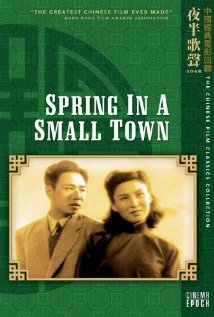
Spring in a Small Town

Mu Fei, China, 1948, bw (8.2*)
Spring is a gentle story of another era in Chinese films, one just after the war, in a world where this war reach out and touched even the lives of simple country people like the central character, Yuwen, movingly portrayed by Wei Wei, who is isolated in a small town, and in an arranged marriage with an ill husband, Liyan (Wu Shi).

The story revolves around memories: of love, and a period of promise, now being stirred to life again by the sudden visit of the husband's long estranged friend Zhang (Wei Li), who is now a city doctor, also a former beau of Yuwen. Zhang brings life back to the stagnant estate of Liyan, and renewed love and passion to Yuwen.

Complicating the story are the doctor's scruples and detachment, her husband's illness and depression, and his young sister's (Chaoming Cui) budding relationship with Zhang. Something subtle is happening and it's nothing as superficial as a straightforward romantic affair for anyone at the estate.

Spring is one of the most beautiful of all Chinese films because the beauty and love are just hints than actual expressions, as we'd find in films today. The world has been forever changed by war, and is coming out of it's winter, into a natural rebith of its own, mirrored by the natural spring all around. Liyan's younger sister provides the human metaphor for this natural springtime, one of renewal, spontaniety, and a natural reception to life and growth.

Read more...

Wednesday, April 27, 2011

A Matter of Life and Death

a.k.a. Stairway to Heaven
Michael Powell, Emric Pressburger, 1946 (9.2*)
Not exactly your average war story: while returning to England from a bombing in 1945, pilot Peter Carter, played by David Niven, is too damaged to make it back, and his parachute is also destroyed. He has his crew bail out, and as what he assumes is his last act, he talks on the radio to an operator named June (Kim Hunter), a young American woman, who is touched by his situation.

Then he jumps out over the ocean, and instead of dying, he wakes up in the surf, walking to shore. It was his time to die, but his death angel (a 'conductor') couldn't find him in all that fog (see quote below). Of course, having already fallen for her, he soon meets June in person, and naturally they fall in love for real. When his angel finds him and tells him of the error, Peter argues that it's not his fault he's still alive, now he's in love, so just leave him in peace. The celestial beings who run heaven agree to a trial to decide his fate, so the trial becomes a matter of life and death for Peter.

He is sent back to earth to prepare for his trial, and continue his life there for a day anyway. There are some very innovative sequences when the angel appears, all the action freezes, but Peter and the angel continue in real-time, once during a ping-pong game with the ball in mid-air. The colors are sumptuous, Powell's attention to color details in small props like chess sets places his films a level above all others in their cinematic artistry. The heavenly trial and corporal earth-time are woven together flawlessly in the story.

This is another beautiful film from Michael Powell and Emric Pressburger, known as The Archers. It's generally assumed that Powell was the director and Pressburger the writer, but they shared each credit. Powell began as a Technicolor® specialist, a color film advisor trained by that company in the late 30's. This is one of their best collaborations, the others being Black Narcissus and The Red Shoes. All are beautiful to look at, among the most artistic in the history of film.

The title was changed to Stairway to Heaven in the U.S., because they thought America wasn't ready for a film with 'death' in the title the year after the war was over. (That's so funny, the U.S. being the top homicide nation of all time). A Matter of Life and Death was Powell's own personal favorite of all his works. IF this had more ratings from viewers (only 7k so far), it would be in the IMDB top 250, the average of 8.1 is high enough to be ranked around 190-200.

Quote: The fog was so thick I could've stepped out of the plane and walked back to England.

Note: Martin Scorsese was heavily influenced by Powell and flew to England to meet him and he brought him back to the U.S. to meet all the other directors, like Coppola and Spielberg, that were also students of his films. Powell was surprised to find that he was this well-respected by the next generation of filmmakers.

Read more...

Saturday, April 23, 2011

Here Comes Mr. Jordan

Alexander Hall, 1941, bw (8.8*)
A man named Joe, played by Robert Montgomery, is grabbed by an angel just before his assumed death, but in heaven it's discovered that he wasn't due to die yet. So due to their own bureaucratic bungling, they decide to send him back down, only his body is no longer available and he has to get another body. He's a professional boxer, due for a title fight, so he's fairly picky and doesn't want just any old body. The head angel, a Mr. Jordan, or Claude Rains, tells him he can't dawdle around or the big guy may change his mind.

Unfortunately, the best one available is a recent murder victim, as his wife and her lover are trying to get rid of a selfish millionaire and live on his money. The one personality trait Joe maintains is his desire to play the saxophone, but he's not very good at it. This is the classic mix-up of godly proportions, and I guess to be accurate you could call it a 'fish out of his body' tale.

This is the original bw classic using this idea, which was later re-written and remade by Warren Beatty and Buck Henry in 1978 as Heaven Can Wait, which featured Beatty as a football player with a clarinet, Julie Christie, James Mason (as Mr. Jordan) and Charles Grodin and Dyan Cannon as the hilarious would-be murderers.

Winner of 2 Oscars® (Story, screenplay) out of 7 nominations, which included picture, director, cinematography, and two for lead actor.

Read more...

Saturday, April 9, 2011

And Then There Were None

René Clair, 1945, bw (8.6*)
This would have to be considered the definitive film of any Agatha Christie mystery novel. Other than changing the ending (yes!), the rest of this black and white classic is very close to her original novel Ten Little Indians (the title was changed to be more 'politically correct').

Ten seemingly random people, including a judge and a doctor, are invited to a remote island as guests of a mysterious Mr. U.N. Own (unknown, get it?). The island appears deserted, and a recording is played at dinner from the missing host, accusing them each of murder. Immediately, one of them is dead, and the game has begun. The guests begin to die one by one, while the remaining guests each accuse each other of being the killer, perhaps even the missing host.

Of course, if you know Christie, then you know the plot hinges usually on one unexpected twist that the reader (filmgoer in this case) will guess about until revealed at the end. This was one of the best of her novels (The Murder of Roger Akroyd being the other), and her fans and mystery fans in general will enjoy this film, even if their suspicions are correct.

The cast includes Oscar winners Walter Huston and Barry Fitzgerald, and also veteran character actors Misha Auer, Roland Young, C. Aubrey Smith, Roland Young, Louis Hayward, and Judith Anderson. This won best film at the 1946 Locarno Film Festival, it's only award.

There's actually a newer updated version from Russia, made in 1987. Some say it's more faithful to the novel, including the original ending; others say it's more ponderous and the subtitling gets out of sync.


Another good filming of a Christie novel is Billy Wilder's Witness For the Prosecution, which we will review later.

Read more...

Sunday, March 20, 2011

She Wore a Yellow Ribbon

John Ford, 1949 (8.4*)
Despite the terrible title, this is one of the best of the John Ford westerns, my favorite of his 'cavalry' films with John Wayne. In this more believable story, Wayne plays a retiring colonel, who is sucked into one last Indian war, something he hoped was all in his past by this point.

The title comes from a young lady, Joanne Dru, at the local fort who's playing one young lieutenant vs another (John Agar and Harry Carey Jr.), and doesn't appear to care which one wins the game. This provides an unnecessary distraction to the real story; unfortunately they chose this particular plotline for the film's title.

I think what I liked about this film vs. the other Ford-Wayne collaberations is that Wayne is finally human, he's simply old and worn out from decades of warring with no end in sight. He's no longer the superhuman ass-kicking American, he's ready to retire in his armchair in front of the tv or radio or perhaps drowsily fishing on a lake somewhere with his dog.

Beautifully photographed, winner of a cinematography Oscar® for Winton C. Hoch

Read more...

Thursday, March 17, 2011

Stray Dog

Akira Kurosawa, Japan, 1949, bw (9.0*)
One of famed director Akira Kurosawa's earliest films, about a rookie detective, played by Toshiro Mifune in one of his first starring roles, who has his gun stolen on a crowded bus. He then searches for his revolver relentlessly after it is used in the commission of a crime, as he then feels personally responsible for any victims of whoever is using his weapon. At the same time, he faces the dirision and ridicule of fellow detectives for having lost his gun to thieves on the street.

Beautifully shot in post-war Tokyo, much of in the dangerous black market streets and alleys. In fact, an assistant director stood in for Tishiro Mifune in some of the scenes shot in dangerous locales where guns were sold and criminals rule. Rarely shooting scenes straight on, most are shot from odd angles as if the viewer is spying, like crime witnesses, on the action from behind walls, doors, from earth level (sometimes you only see the feet of the detective), through windows, or rooftops. Kurosawa has put his own stamp on a tense thriller in the style of American film noir, and he actually caused a wave of Japanese police films following the success of this film.

A must-see classic for fans of Kurosawa and Japanese cinema; from the Criterion Collection. It may be argued that his early black-and-white period, which includes his masterpiece The Seven Samurai, was his most successful creatively - it's certainly my favorite era of his.

Read more...

Thursday, February 10, 2011

The Red Shoes

Michael Powell, Emeric Pressburger, 1948 (8.3*)
One of the most beautifully shot films to have come from the Powell and Pressburger collaberation, known as "The Archers".

Moira Shearer plays a new ballet discovery whose life begins to eerily parallel one of her characters, whose dancing is enhanced by a pair of magical red shoes. She is soon torn between the love of her life and her love of dancing. Still one of the best films ever about dancing itself, this film has never become dated due to the artistry of Powell.

Director Michael Powell was an early technicolor specialist in the 30's before becoming a director and it shows in his films such as this one and Black Narcissus. Together, he and Pressburger usually shared directing credit, though it's understood that Pressburger was normally the screenwriter and Powell the director. This was recently voted #5 in a poll of all-time U.K. films by a panel of film pros there. In fact, Michael Powell had six films in the top 30. (which include Black Narcissus, A Matter of Life and Death, Life and Death of Colonel Blimp, and A Canterbury Tale)

Read more...

Monday, January 24, 2011

Life With Father

Michael Curtiz, 1947 (8.2*)
From the director of Casablanca comes this wonderful classic comedy of the family patriarch and universal curmudgeon, a film of the long-running Broadway play which thrives on probably the best performance ever by William Powell, better known for the Thin Man series. This is author Clarence Day's coming-of-age story, which centers on the aristocratic and authoritarian, yet humorous father. Classic comedienne Irene Dunne is his long suffering wife.

Powell created the epitome of the stubborn, self-righteous, but lovable family man, later emulated in shows like The Honeymooners and All in the Family. In this first film (there were sequels), much is made of the fact that he has never been baptized, so everyone is convinced he's going to hell when he dies, which seems to worry everyone else more than father.

Read more...

Wednesday, January 5, 2011

Now, Voyager

Irving Rapper, 1942, bw (9.0*)
One of the best Bette Davis films, this is an uncompromising adult story that was all too rare in Hollywood's heyday of crowd-pleasing happy films with pat stories.

Davis has a domineering mom that drives her to a sanitarium. There she finds a kindred spirit, the daughter of her therapist (Claude Rains) who moves in with her after they recover and leave. She takes an ocean voyage on which she falls in love with a married man, Paul Henreid. I can't say more without spoiling the story and plot, but suffice to say that Davis had the best discretion of any actress for choosing which scripts were best for herself - she turned down Gone With the Wind after filming Jezebel the year before.

If not for the astounding All About Eve (1950), this would be my favorite Davis film. Ironically, the film's release was held up while waiting for the symphonic Max Steiner (Gone With the Wind) score, which Davis felt would "walk all over the actor's lines" and hurt her chance for another Oscar. She was right of course, the music is entirely unnecessary and detracts rather than enhances.

This is a must-see for fans of Davis and intelligent classic films without a formulaic storyline.

Quote: I didn't want to be born. You didn't want me to be born. It's been a calamity on both sides.
Quote2: Oh Jerry, don't let's ask for the moon. We have the stars.


Note: The daughter of Claude Rains, in a recent TCM interview, said that Davis always loved Rains, would often show up at his house during troubled marriages, once spending six weeks, but he would never commit to her. Women were attracted by his self-confidence, not to mention his incredible talent.

Read more...

Friday, July 30, 2010

Leave Her To Heaven

John M. Stahl, 1945 (8.6*)
Exotic locations, the impeccable beauty of Gene Tierney, and the Oscar®-winning cinematography of Leon Shamroy (one of his four Oscars®) make this one of the most beautiful films to view in color. The film begins on a train in New Mexico, where an author, played by Cornel Wilde in an understated performance, meets a gorgeous young woman, Tierney, who's reading his latest novel.

The two fall in love amid the beautiful scenery of Rancho Jacinto in the mountains near Taos, New Mexico, with Tierney dropping her present fiance, a rising young lawyer well-played by Vincent Price, and proposing to Wilde after just a couple of days of dazzling him with her beauty. In one unforgettable scene, he witnesses her scattering her fathers ashes on horseback high up on a mountain plateau at dawn with her mother and cousin.

The marriage shifts to Warm Springs, Ga (where I work, about a mile from the location in the film!) to Wildes' polio stricken young brother David, played by Darryl Hickman of Dobie Gillis on tv fame. They then all move to Deer Lake, Maine, to Wilde's hidden fishing lodge, so the newlyweds really get little intimacy. Tierney's character grows increasingly possessive of her husband, even becoming jealous of her cousin, and half-sister, on her infrequent visits, played by Jeanne Crain, who holds her own vs. Tierney's onscreen beauty - the two actually resemble relatives.

This is really basic film noir, even if wrapped in a colorfully trimmed package. We watch major characters deteriorate as they turn lemonade into lemons, and are eventually shocked by unexpected events of mental cruelty. This was one of Shamroy's four Oscars®, and the impeccable art direction also received an Oscar® nomination, as did Tierney, who received the only Oscar® nomination of her career, losing to Joan Crawford. A must-see for fans of 40's glamour and film noir classics, from a novel by Ben Ames Williams.

Read more...

Wednesday, July 14, 2010

His Girl Friday

Howard Hawks, 1940, bw (9.0*)
This remake of the Ben Hecht play The Front Page, also made as a film by Lewis Milestone in 1931, has absolutely classic comedic banter between Cary Grant and ex-wife Rosalind Russell as news reporters on a big homicide case. Apparently fearing she wasn't getting many good lines, Russell hired an outside writer to give her some lines to 'improvise' during the shooting. The result is a rapid fire, news teletype style of back and forth wisecracking that's practially the archetype for this style of comedy, often copied on tv sitcoms but never with this much energy.

The story of a convicted murderer about to be executed and escaping takes a back seat to the subliminal romantic repartee of the two stars - Cary Grant was never better, never this sharp again. It's like the Thin Man series on steroids, or a case of Red Bull to start the newsday. This is my favorite Howard Hawks film, maybe his most classic of all. It certainly had an influence on many other comedies to follow. It may be too energetic and 'relentless' to some, but to me Hawks managed this frantic pace well and showed everyone how it could be done.

Read more...

About Me

My photo
Artist, photographer, composer, author, blogger, metaphysician, herbalist

About This Blog

This is our new template: ProBlogger.


These are the individual film reviews of what I'm considering the best 1000 dvds available, whether they are films, miniseries, or live concerts. Rather than rush out all 1000 at once, I'm doing them over time to allow inclusion of new releases - in fact, 2008 has the most of any year so far, 30 titles in all; that was a very good year for films, one of the best ever.


Author at EZines

  © Blogger templates ProBlogger Template by Ourblogtemplates.com 2008

Back to TOP